
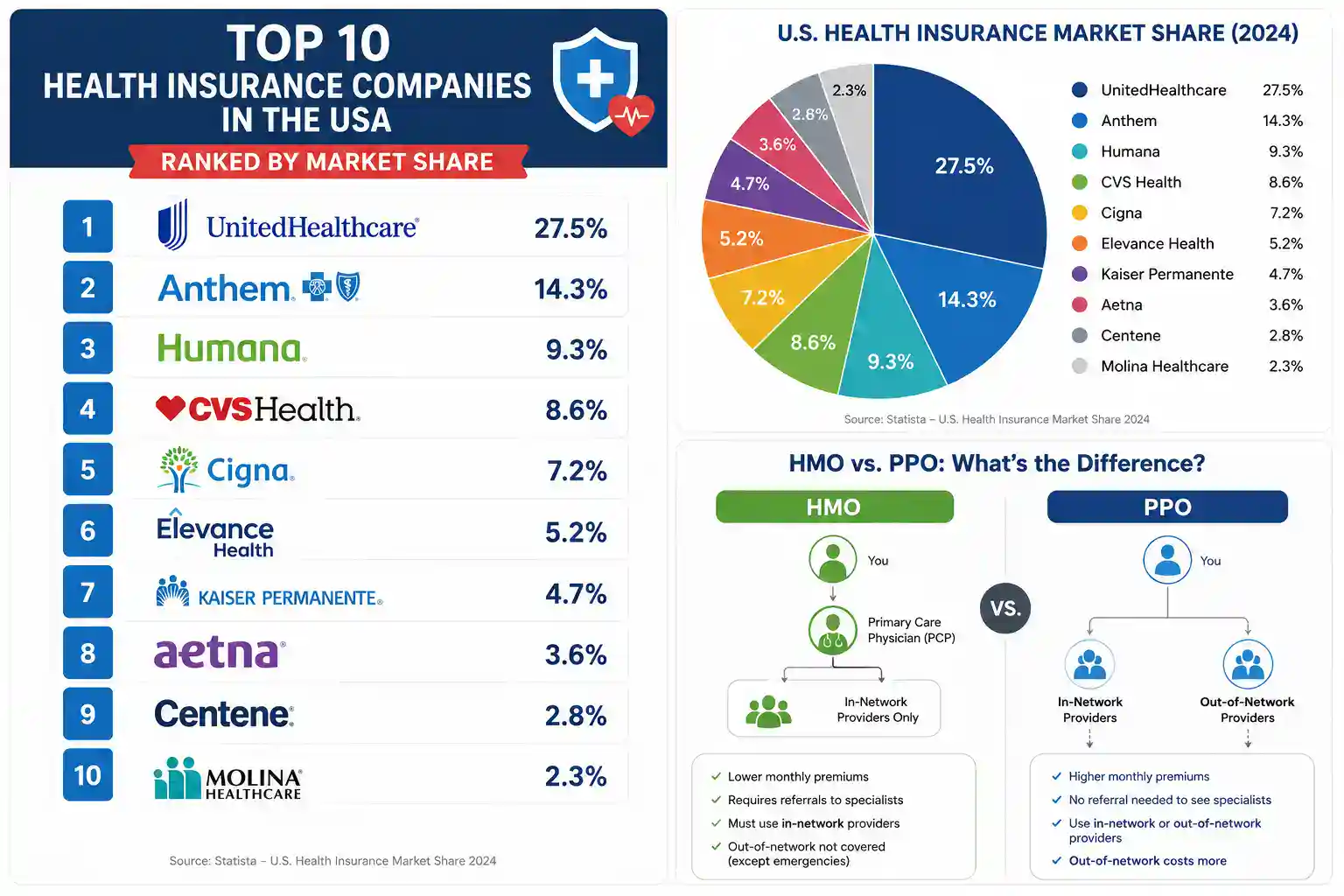
See the top 10 health insurance companies in the USA for 2026, ranked by market share and coverage. Compare providers before you enroll.
Quick Answer: The Top 10 health insurance companies in the USA by market share are UnitedHealthcare, CVS Health (Aetna), Elevance Health, Kaiser Permanente, Cigna, Humana, HCSC, Centene, Molina Healthcare, and the broader Blue Cross Blue Shield network. Rankings vary by revenue, enrollment, and customer satisfaction, so the best pick depends on your state, budget, and health needs.
If you’ve ever tried to pick a health plan, you know the feeling: a dozen unfamiliar company names, confusing acronyms, and a decision that affects your wallet and your health for the next year. You’re not alone millions of Americans go through open enrollment every fall feeling the same way.
This guide breaks down the 10 largest health insurance companies in the United States, based on market share data from the National Association of Insurance Commissioners (NAIC) and company enrollment figures. You’ll learn what makes each company different, who they tend to work best for, and what to check before you sign up for a plan.
How We Ranked These Companies
Company size in the health insurance industry is usually measured a few different ways: total market share of premiums written, number of members enrolled, or annual revenue. This list is built primarily around market share and enrollment size, using publicly reported NAIC data and company disclosures.

Bigger doesn’t automatically mean better for you personally. A smaller, regional insurer might have a stronger doctor network in your city than a national giant. Keep that in mind as you read through the list this is a map of the industry’s biggest players, not a personal recommendation for any one person’s situation.
1. UnitedHealthcare (UnitedHealth Group)
UnitedHealthcare is the insurance arm of UnitedHealth Group, and it holds the largest share of the U.S. health insurance market controlling roughly 16% of the national market based on total premiums written, according to ValuePenguin’s analysis of NAIC data.
What it offers: Employer-sponsored plans, ACA marketplace plans, Medicare Advantage, and Medicaid managed care, backed by one of the largest provider networks in the country.
Who it may benefit: People who want a nationwide network and don’t mind a larger, more corporate insurance experience common with big employers offering UnitedHealthcare as a benefit.
Limitations: Size doesn’t always mean satisfaction. Some independent rating agencies have noted UnitedHealthcare has slipped in customer satisfaction rankings in recent years, particularly around affordability and claims experience so it’s worth checking recent reviews for your specific plan type before enrolling.
2. CVS Health / Aetna
Aetna, now part of CVS Health, has climbed in market share rankings in recent years and holds an estimated market share of just over 7%, according to industry reporting citing NAIC’s latest report.
What it offers: Individual and family plans, employer group plans, Medicare Advantage, and integration with CVS pharmacies and MinuteClinic locations for everyday care needs.
Who it may benefit: People who already use CVS pharmacies and want the convenience of connected pharmacy, urgent care, and insurance services under one company.
Limitations: Plan availability and pricing can vary significantly depending on your state and whether you’re shopping the ACA marketplace or an employer plan.
3. Elevance Health
Formerly known as Anthem, Elevance Health is one of the largest for-profit players operating under the Blue Cross Blue Shield brand, with Blue-branded plans across 14 states and deep ties to the broader national BCBS network.
What it offers: Individual, family, and employer plans through its regional Blue Cross Blue Shield brands, plus behavioral health, pharmacy, and virtual care services through its Carelon division.
Who it may benefit: Residents of the states where Elevance operates Blue Cross plans directly, and people who want a company with strong name recognition and broad provider access.
Limitations: Coverage details and plan names differ by state, since Elevance operates under separate regional Blue brands rather than one unified national plan.
4. Kaiser Permanente
Kaiser Permanente takes a different approach than most insurers on this list it combines insurance and care delivery into a single integrated system, with doctors, hospitals, and the insurance plan all operating under one roof.
What it offers: HMO-style integrated health plans across eight to nine states plus Washington, D.C., serving over 8.5 million members, according to ValuePenguin’s company data summary.
Who it may benefit: People who live in a Kaiser service area and are comfortable with an HMO structure, where you generally see doctors within the Kaiser network. Kaiser has consistently scored well on quality-of-care ratings.
Limitations: Kaiser is only available in a limited number of states, and its closed-network HMO model means less flexibility to see out-of-network specialists compared to a PPO.
5. Cigna
Cigna has a strong presence in employer-sponsored insurance and is particularly well known for supporting expatriates and frequent international travelers with global health coverage options.
What it offers: Employer group plans, individual and family plans in select states, Medicare Advantage, and international/global health plans.
Who it may benefit: Employees at large companies offering Cigna as a benefit, and people who travel internationally and need coverage that extends beyond the U.S.
Limitations: Cigna’s individual marketplace presence is smaller in some states compared to competitors, so availability depends heavily on where you live.
6. Humana
Humana has built its reputation primarily around Medicare, and it’s one of the largest providers of Medicare Advantage plans in the country.
What it offers: Medicare Advantage plans across 46 states and Washington, D.C., covering about 85% of U.S. counties, according to Insurance Business Magazine, plus standalone prescription drug plans and a growing Medicaid footprint.
Who it may benefit: Medicare-eligible individuals looking for a Medicare Advantage plan with strong nationwide availability, and people who want insurance paired with primary care services through Humana’s CenterWell clinics.
Limitations: Humana is much less of a factor in the individual ACA marketplace or employer-sponsored space compared to its Medicare business it’s best known for one specific niche rather than broad coverage.
7. HCSC (Health Care Service Corporation)
HCSC operates Blue Cross Blue Shield plans in several states and is one of the largest customer-owned (mutual) health insurers in the country.
What it offers: Blue Cross Blue Shield branded individual, family, and employer plans in the states it serves, including Illinois, Texas, Oklahoma, New Mexico, and Montana.
Who it may benefit: Residents of HCSC’s operating states who want a Blue Cross Blue Shield plan backed by a large, established regional insurer with strong local provider networks.
Limitations: Like other regional Blues, HCSC only operates in a handful of states, so it’s not an option nationwide.
8. Centene Corporation
Centene has built one of the largest Medicaid managed care businesses in the country and also sells ACA marketplace plans under its Ambetter brand.
What it offers: Medicaid managed care plans, ACA marketplace plans (Ambetter), and some Medicare products, with a strong focus on serving lower-income and underserved populations.
Who it may benefit: People enrolling in Medicaid or shopping the ACA marketplace who want a lower-cost plan option, particularly in states where Ambetter has a strong presence.
Limitations: Centene’s plans often come with narrower provider networks than larger commercial insurers, since the business model is built around cost efficiency for public programs.
9. Molina Healthcare
Molina Healthcare is another major player focused primarily on government-sponsored health programs.
What it offers: Medicaid managed care and Medicare Advantage plans, along with some ACA marketplace options in select states.
Who it may benefit: Medicaid enrollees and low-income individuals and families who qualify for government-subsidized coverage in a Molina service area.
Limitations: Molina has ranked lower than average on some independent customer satisfaction surveys, so it’s worth researching plan reviews specific to your state before enrolling.
10. Blue Cross Blue Shield Association Network
Rather than being a single company, Blue Cross Blue Shield is a federation of independent, locally operated companies that together cover a very large share of Americans spanning employer plans, ACA marketplace plans, and Medicare products across nearly every state.
What it offers: Region-specific Blue Cross Blue Shield plans, each operated by an independent licensee (including Elevance and HCSC, listed above, as well as many other independent Blues).
Who it may benefit: People who want the broad brand recognition and provider acceptance that comes with the Blue Cross Blue Shield name, since Blue plans are widely accepted by doctors and hospitals nationwide.
Limitations: Because each regional Blue is independently operated, coverage, pricing, and plan quality can vary a lot depending on which state’s Blue Cross Blue Shield company you’re comparing.
Comparison Table
| Company | Known Best For | Multi-State Availability | Plan Types |
|---|---|---|---|
| UnitedHealthcare | Largest overall network | Nationwide | Employer, ACA, Medicare, Medicaid |
| CVS Health / Aetna | Pharmacy + insurance integration | Nationwide | Employer, ACA, Medicare |
| Elevance Health | Regional Blue Cross plans | 14 states | Employer, ACA, Medicare |
| Kaiser Permanente | Integrated care model | 8–9 states + D.C. | HMO employer, ACA, Medicare |
| Cigna | Global/international coverage | Select states + global | Employer, ACA (select states), Medicare |
| Humana | Medicare Advantage | 46 states + D.C. | Medicare, Medicaid |
| HCSC | Regional Blue Cross plans | 5 states | Employer, ACA, Medicare |
| Centene | Medicaid + ACA (Ambetter) | Multiple states | Medicaid, ACA, Medicare |
| Molina Healthcare | Government-sponsored plans | Select states | Medicaid, Medicare, ACA (select states) |
| BCBS Association Network | Broad provider acceptance | Nearly nationwide | Employer, ACA, Medicare |
How to Choose the Right Company for You
Bigger companies aren’t automatically the best fit. Here’s what actually matters when you compare health insurance companies:
- Check that your doctors and hospitals are in-network first. A “top” company means little if your preferred doctor isn’t covered.
- Compare total cost, not just the premium. Look at the deductible (what you pay before coverage kicks in), copays, and out-of-pocket maximum together.
- Match the plan type to how you use care. HMOs like Kaiser tend to cost less but require referrals; PPOs cost more but offer more flexibility to see specialists directly.
- Look up the company’s complaint index. State insurance departments and the NAIC publish complaint ratios a useful, unbiased way to compare customer experience.
- Confirm availability in your state. Several companies on this list, including Kaiser and HCSC, only operate in specific states or regions.
Conclusion
The 10 companies above UnitedHealthcare, CVS Health/Aetna, Elevance Health, Kaiser Permanente, Cigna, Humana, HCSC, Centene, Molina Healthcare, and the broader Blue Cross Blue Shield network together cover the large majority of insured Americans. The “biggest” company isn’t always the “best” one for your situation; your ideal choice depends on your state, your budget, and whether your preferred doctors are in-network. Before you enroll, compare at least two or three plans side by side and confirm your specific providers are covered.
Frequently Asked Questions
1. What is the largest health insurance company in the USA?
UnitedHealthcare, part of UnitedHealth Group, holds the largest share of the U.S. health insurance market, at roughly 16% based on recent NAIC data.
2. Which health insurance company has the best customer satisfaction?
Rankings vary by survey and year. Kaiser Permanente and Humana have both scored well in recent independent customer satisfaction and quality-of-care ratings, though results differ by state and plan type.
3. Is a bigger health insurance company always better?
Not necessarily. Company size relates to market share and provider network breadth, not automatically to service quality, cost, or fit for your specific health needs.
4. What’s the difference between an HMO and a PPO?
An HMO (like Kaiser’s plans) typically requires you to choose a primary care doctor and get referrals to see specialists, usually at a lower cost. A PPO offers more flexibility to see any provider, including out-of-network specialists, usually at a higher cost.
5. Can I buy health insurance directly from these companies?
Some plans are only available through an employer or through the ACA marketplace at HealthCare.gov or your state’s exchange, rather than purchased directly from the insurer.
6. Which companies offer Medicare Advantage plans?
UnitedHealthcare and Humana are the two largest Medicare Advantage providers, together accounting for a large share of enrollees nationwide. Several other companies on this list, including Aetna, Cigna, and Elevance, also offer Medicare Advantage plans.
7. Are Blue Cross Blue Shield plans the same everywhere?
No. Blue Cross Blue Shield is a federation of independently operated companies (including Elevance and HCSC), so coverage, pricing, and plan options differ by state.
8. How do I check if a health insurance company is licensed in my state?
You can verify licensing and check complaint history through your state’s Department of Insurance or the NAIC’s consumer resources.
9. What’s the cheapest way to compare health insurance plans?
Start with the ACA marketplace at HealthCare.gov if you don’t have employer coverage it lets you compare plans from multiple companies side by side, and you may qualify for subsidies that lower your premium.
10. Do these rankings change every year?
Yes. Market share shifts due to mergers, acquisitions, and enrollment changes, so it’s worth checking updated NAIC data annually rather than relying on older rankings.
Editorial Standards & Disclaimer
Author: Written by the NotifyToYou Editorial Team, which researches insurance and personal finance topics using government and industry-authoritative sources.
Reviewer Note: This article has not been reviewed by a named licensed insurance agent. Content is based on publicly available NAIC market share data and industry reporting current as of the Last Reviewed Date above; consult a licensed insurance agent for guidance specific to your situation.
Editorial Standards: Our content is researched using government and industry-authoritative sources, fact-checked before publishing, and updated on the schedule noted above. We do not accept payment in exchange for favorable rankings or reviews.
Disclaimer: This article is for educational purposes only and does not constitute financial, insurance, tax, or legal advice. Rates, coverage, and eligibility vary by provider, state, and individual circumstances. Consult a licensed insurance agent, financial advisor, or tax professional before making a decision.
Rate & Eligibility Variation Note: Market share figures, revenue estimates, and enrollment numbers mentioned are based on the most recent publicly available data and may have changed since publication. Actual plan costs depend on factors such as age, location, health, coverage amount, and the provider’s underwriting guidelines.
Read More – American Health Insurance: Complete Guide to Coverage, Costs, Plans, Claims & Benefits (2026)


