
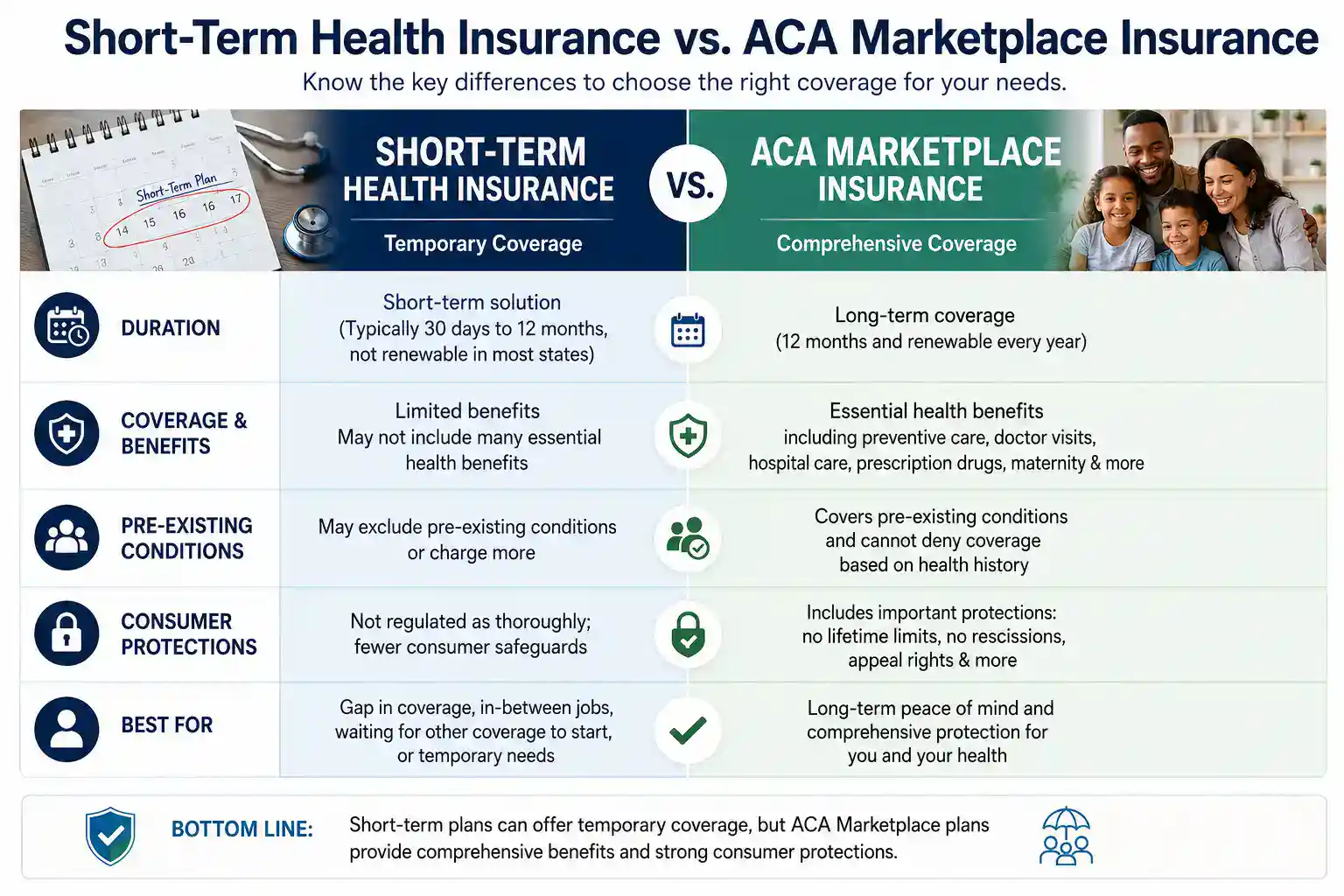
Learn how short term health insurance plans work, what they cover, their limitations, costs, eligibility, and how they compare with ACA Marketplace coverage.
Important 2026 update: Federal rules surrounding short-term, limited-duration insurance (STLDI) are currently in a transition period. The 2024 federal rule established a three-month initial term and four-month maximum coverage period, but in August 2025 the federal agencies announced that they would not prioritize enforcement of those provisions while new rulemaking is considered. The National Association of Insurance Commissioners (NAIC) confirms that this enforcement suspension remains relevant as of July 2026. State laws can be stricter.
If you’re between jobs, waiting for employer coverage to begin, or facing another temporary gap in health insurance, you may come across short term health insurance plans.
These plans can provide temporary medical coverage, but they are not the same as ACA-compliant Marketplace insurance. They can have different rules for pre-existing conditions, covered services, deductibles, exclusions, and renewals.
That’s why a lower monthly premium doesn’t necessarily mean a short-term plan is the better deal.
Short-term health insurance is generally designed to bridge a temporary coverage gap—not to replace comprehensive health insurance for everyone. Federal agencies and the NAIC emphasize that these plans have different consumer protections and benefit structures from comprehensive coverage.
What Is Short Term Health Insurance?
Short-term health insurance, formally called short-term, limited-duration insurance (STLDI), is temporary health coverage generally intended to fill a gap between more comprehensive health insurance policies.

For example, someone might consider short-term coverage when:
- They are between jobs.
- Employer-sponsored coverage hasn’t started yet.
- They recently graduated and lost student coverage.
- They are waiting for another source of comprehensive coverage.
- They missed an enrollment opportunity and need to investigate temporary options.
The plans are generally sold outside the ACA Marketplace and aren’t subject to all of the federal consumer protections that apply to comprehensive individual-market coverage.
How Do Short-Term Health Insurance Plans Work?
A short-term plan typically involves:
- Choosing a plan
- Applying for coverage
- Answering questions about eligibility and health history, depending on the insurer and state
- Paying a premium
- Using the plan according to its network, deductible, coinsurance, exclusions, and benefit rules
- Ending coverage when the policy term expires
The important distinction is that short-term insurance isn’t simply a cheaper version of an ACA Marketplace plan.
It can have substantially different coverage rules.
Some short-term plans may use medical underwriting, meaning an insurer can consider health information when determining eligibility or coverage. They may also exclude pre-existing conditions.
How Long Can Short-Term Health Insurance Last?
This is one of the most important areas to understand in 2026.
The 2024 federal rule defined STLDI as having:
- An initial contract term of no more than three months
- A maximum coverage period of no more than four months, including renewals or extensions
Those provisions applied to coverage periods beginning on or after September 1, 2024.
However, on August 7, 2025, the U.S. Departments of Labor, Health and Human Services, and Treasury announced that they did not intend to prioritize enforcement of violations related to the 2024 STLDI definition while future rulemaking was being considered.
The federal regulatory agenda currently lists a proposed STLDI rule for August 2026, indicating that the federal framework may change again.
What does that mean for consumers?
Do not assume that every short-term plan can legally be sold for the same length of time nationwide.
State insurance laws can impose shorter limits or prohibit short-term plans altogether. The NAIC specifically notes that state rules may differ.
Before purchasing, verify the rules in your state and the exact duration offered by the insurer.
What Does Short-Term Health Insurance Cover?
Coverage varies significantly by plan.
Depending on the policy, short-term health insurance may help cover services such as:
- Doctor visits
- Urgent care
- Emergency services
- Hospital care
- Diagnostic testing
- Some prescription drugs
- Specialist services
- Certain outpatient services
But never assume that a service is covered simply because it is medically necessary.
The policy may contain:
- Deductibles
- Coinsurance
- Copayments
- Coverage limits
- Exclusions
- Waiting periods
- Network restrictions
- Pre-existing-condition exclusions
- Specific benefit limitations
Read the actual plan documents before enrolling.
What Does Short-Term Health Insurance Usually Not Cover?
Short-term plans aren’t required to provide the same essential-health-benefit package and consumer protections as ACA Marketplace plans.

Depending on the policy, exclusions may include or limit:
- Pre-existing conditions
- Maternity care
- Prescription medications
- Mental health services
- Substance-use treatment
- Preventive services
- Certain specialist care
- Certain hospital services
The exact exclusions vary by policy and state.
KFF notes that short-term plans often don’t include protections found in Marketplace plans and may exclude pre-existing conditions and services such as prescription drugs, mental health care, substance-use treatment, or maternity care.
Are Pre-Existing Conditions Covered?
Often, no.
This is one of the biggest differences between short-term insurance and ACA Marketplace coverage.
ACA-compliant Marketplace plans generally cannot deny coverage or charge more because of a pre-existing condition.
Short-term plans are exempt from many of the ACA’s individual-market requirements and may exclude pre-existing conditions.
If you have an ongoing medical condition, take regular medication, or expect significant medical care, carefully compare short-term coverage with comprehensive alternatives before enrolling.
Short-Term Health Insurance vs. ACA Marketplace Insurance
| Feature | Short-Term Health Insurance | ACA Marketplace Plan |
| Main purpose | Temporary coverage | Comprehensive individual coverage |
| ACA-compliant | Generally no | Yes, for qualified Marketplace plans |
| Pre-existing conditions | May be excluded | Generally covered |
| Essential health benefits | Not required in the same way | Required for Marketplace plans |
| Maternity coverage | May be excluded | Covered as an essential health benefit |
| Mental health coverage | May be limited or excluded | Required as an essential health benefit |
| Prescription coverage | Varies | Included as part of essential health benefits, subject to plan rules |
| Enrollment rules | Varies by plan/state | Open Enrollment and qualifying Special Enrollment Periods |
| Subsidies | Generally not available through Marketplace subsidies | Premium tax credits may be available if eligible |
| Consumer protections | More limited | Stronger ACA protections |
Short-term plans can look less expensive because they don’t have to provide the same comprehensive benefits and protections. KFF specifically warns consumers not to treat these products as equivalent to Marketplace coverage.
How Much Does Short-Term Health Insurance Cost?
There is no single national price for short-term health insurance.
Your premium can depend on factors such as:
- Age
- Location
- Coverage period
- Deductible
- Coinsurance
- Maximum benefit limits
- Network
- Plan design
- Insurer
- State regulations
- Health information considered by the insurer
A very low premium can be misleading if the plan has a high deductible, substantial exclusions, or limited benefits.
Don’t compare premiums alone.
Compare:
Monthly premium + deductible + coinsurance + out-of-pocket exposure + exclusions + network + prescription coverage.
The cheapest monthly premium may not be the lowest-cost option if you need significant medical care.
Why Are Short-Term Plans Sometimes Cheaper?
Short-term plans can have lower premiums because they generally don’t have to follow all of the ACA’s comprehensive individual-market rules.
They may:
- Exclude pre-existing conditions
- Cover fewer services
- Use medical underwriting
- Have different benefit limits
- Exclude maternity care
- Limit certain prescription or mental-health benefits
KFF notes that these plans can appear cheaper than Marketplace plans precisely because they don’t provide all of the same benefits and consumer protections.
So the right question isn’t:
“Which plan has the lowest premium?”
Instead ask:
“Which plan provides the coverage I actually need at an affordable total cost?”
Who Might Consider Short-Term Health Insurance?
Short-term coverage may be worth investigating if you:
- Have a genuinely temporary gap in comprehensive coverage.
- Are waiting for employer-sponsored coverage to begin.
- Need coverage for a limited transition period.
- Don’t qualify for another immediate comprehensive option.
- Understand the policy’s exclusions and limitations.
- Have verified that the plan is permitted in your state.
The traditional purpose of STLDI is precisely to bridge temporary gaps in coverage.
Who Should Be Especially Careful With Short-Term Plans?
Short-term insurance deserves extra scrutiny if you:
- Have a pre-existing medical condition.
- Take expensive or ongoing prescription medications.
- Are pregnant or planning pregnancy.
- Need regular mental-health treatment.
- Expect surgery or hospitalization.
- Need regular specialist visits.
- Have significant ongoing medical needs.
- Need comprehensive preventive care.
- Want predictable long-term coverage.
A cheaper policy isn’t necessarily a good fit if it excludes the care you are most likely to need.
Pros and Cons of Short-Term Health Insurance
Potential Advantages
Lower Premiums
Some short-term policies may have lower monthly premiums than comparable comprehensive coverage.
Temporary Coverage
They can help bridge a gap when other coverage isn’t immediately available.
Potential Enrollment Flexibility
Depending on state law and insurer rules, short-term plans may be available outside ACA Marketplace enrollment periods.
Different Plan Designs
Consumers may find a range of deductibles and benefit structures.
Potential Disadvantages
Pre-Existing Conditions May Be Excluded
This can be a major limitation.
Benefits May Be Limited
Coverage can differ substantially from comprehensive insurance.
Maternity Care May Be Excluded
Pregnancy-related care may not be covered.
Mental Health Coverage May Be Limited
Unlike Marketplace plans, short-term policies aren’t required to provide the same essential health benefits.
Prescription Coverage May Be Limited
A plan may not cover your medications or may provide different benefits.
State Availability Varies
Some states restrict or prohibit short-term plans.
Renewal May Not Be Guaranteed
You shouldn’t assume that you can simply renew the policy indefinitely.
What Are the Biggest Risks of Short-Term Health Insurance?
The biggest risk isn’t necessarily that the plan is “bad.”
It’s that the consumer may assume it provides comprehensive coverage when it doesn’t.
For example, imagine someone buys a low-premium plan shortly before discovering they need treatment for a medical condition.
If the condition qualifies as pre-existing under the policy, the insurer may not cover related care.
That’s why reading the policy’s exclusions is just as important as comparing premiums.
Are Short-Term Health Plans ACA-Compliant?
Generally, no.
Short-term, limited-duration insurance is excluded from the federal definition of individual health insurance and therefore isn’t subject to many of the ACA requirements applicable to comprehensive individual-market plans.
This doesn’t mean that short-term plans are automatically illegal or that they provide no value.
It means consumers need to understand that they are a different type of coverage.
Can You Buy Short-Term Health Insurance Through HealthCare.gov?
No.
HealthCare.gov and state Marketplaces offer qualified Marketplace health plans rather than short-term plans.
KFF explains that Marketplace websites sell qualified health plans, while short-term and other less comprehensive products may be sold through private enrollment websites.
If you’re looking for comprehensive ACA coverage, start with HealthCare.gov or your state’s official Marketplace.
Can Short-Term Insurance Replace Marketplace Insurance?
For some people with a temporary gap, it can provide a form of temporary coverage.
But it shouldn’t automatically be treated as a substitute for comprehensive Marketplace insurance.
Marketplace plans provide protections and benefits that short-term plans generally don’t have.
If you’re eligible for Marketplace financial assistance, the premium difference may also be smaller than you expect.
Before choosing short-term coverage, compare it with:
- Marketplace coverage
- Employer coverage
- Coverage through a spouse
- Medicaid
- CHIP
- COBRA, when applicable
What Is the Difference Between Short-Term Insurance and COBRA?
These options serve different purposes.
COBRA generally allows eligible workers and their families to continue an existing employer-sponsored health plan for a limited period after certain qualifying events.
Short-term insurance is a separate individual insurance product designed primarily for temporary gaps.
COBRA may be more expensive because you’re generally continuing the existing plan and paying the applicable premium costs, but it can provide continuity of benefits and providers.
Short-term insurance may have a lower premium but can have substantially different coverage and exclusions.
Compare the actual costs and benefits before choosing.
Can You Get a Subsidy for Short-Term Health Insurance?
Generally, ACA premium tax credits are associated with eligible Marketplace coverage, not short-term plans.
If cost is the reason you’re considering short-term insurance, check whether you qualify for Marketplace financial assistance before assuming short-term coverage is cheaper.
Eligibility depends on your circumstances and applicable federal rules.
What Should You Check Before Buying a Short-Term Health Plan?
Use this checklist.
1. Is the Plan Available in Your State?
State laws can prohibit or restrict short-term insurance.
For example, Illinois prohibits insurers from selling STLD policies to Illinois residents beginning January 1, 2025.
Don’t rely on information from another state’s insurance website.
2. How Long Does Coverage Actually Last?
Check:
- Initial policy term
- Renewal provisions
- Extension provisions
- Maximum total coverage
- State-specific limits
Don’t assume a plan advertised as “12-month coverage” is necessarily subject to the same rules in every state.
3. Are Pre-Existing Conditions Excluded?
Read the definition carefully.
Don’t simply look for the phrase “pre-existing condition.”
Check how the policy defines and handles it.
4. What Services Are Excluded?
Look specifically for:
- Maternity
- Prescription drugs
- Mental health
- Preventive care
- Specialist care
- Hospitalization
- Emergency care
- Diagnostic testing
5. What Is the Deductible?
A low premium paired with a very high deductible may not provide the financial protection you expect.
6. What Is the Maximum Financial Exposure?
Look for:
- Out-of-pocket maximum
- Coinsurance
- Benefit limits
- Lifetime or annual limits, if applicable
- Exclusions
Don’t assume every short-term plan uses the same cost-sharing structure as an ACA Marketplace plan.
7. Are Your Doctors in Network?
Check the actual provider network.
A plan that doesn’t include your preferred doctors or hospitals may be less useful than expected.
8. Are Your Prescriptions Covered?
Check each important medication individually.
Don’t assume a prescription is covered simply because the plan advertises prescription benefits.
Questions to Ask Before Enrolling
Before paying for a short-term plan, ask:
- Is this short-term, limited-duration insurance?
- Is it available in my state?
- How long is the initial policy term?
- Can it be renewed?
- What is the maximum coverage period?
- Are pre-existing conditions excluded?
- Are maternity services covered?
- Are prescription medications covered?
- Are mental-health services covered?
- What is the deductible?
- What is the coinsurance?
- Is there an out-of-pocket maximum?
- Which doctors and hospitals are in network?
- What happens if I become sick while covered?
- What happens when the policy expires?
- Could I qualify for comprehensive Marketplace coverage instead?
If an insurance seller cannot clearly answer these questions, pause before purchasing.
How to Compare Short-Term Health Insurance Plans
Don’t create your comparison based on monthly premiums alone.
Use this framework:
| Factor | What to Check |
| Premium | Monthly and total cost |
| Deductible | Amount you pay before certain benefits begin |
| Coinsurance | Your percentage of covered costs |
| Out-of-pocket exposure | Maximum financial responsibility, if applicable |
| Coverage period | Initial term and possible extensions |
| Pre-existing conditions | Exclusions and definitions |
| Prescription drugs | Formulary and cost-sharing |
| Hospital care | Limits and exclusions |
| Specialist care | Coverage and network |
| Mental health | Benefits and limitations |
| Maternity | Whether covered |
| Network | Doctors and hospitals available |
| State rules | Whether the product is permitted |
Short-Term Health Insurance May Not Be the Cheapest Overall
Imagine two options:
Plan A
- Lower monthly premium
- High deductible
- Excludes pre-existing conditions
- Limited prescription coverage
- Limited maternity benefits
Plan B
- Higher monthly premium
- Broader coverage
- ACA protections
- Better prescription coverage
- Coverage for pre-existing conditions
- Potential financial assistance
Plan A may appear cheaper on an advertisement.
But Plan B could be financially preferable if you expect to use healthcare services.
Always compare total potential costs and coverage—not just the premium.
How to Find Comprehensive Alternatives
If you need health coverage, investigate all of your available options.
Potential sources include:
Employer Coverage
If you recently started a job or are changing jobs, ask when employer coverage begins.
Spouse’s Employer Plan
A spouse’s plan may provide another option depending on eligibility and enrollment rules.
ACA Marketplace
Check whether you qualify for a Marketplace plan or a Special Enrollment Period.
Medicaid
Eligibility varies by state and individual circumstances.
CHIP
Families with eligible children may have another coverage option.
COBRA
If you recently lost employer-sponsored coverage, investigate whether COBRA continuation applies.
Is Short-Term Health Insurance Worth It?
It depends on why you need coverage and what the policy actually covers.
Short-term insurance can make sense for some people who need temporary protection during a coverage transition.
But it can be a poor fit if you need comprehensive benefits, have ongoing medical needs, or expect significant healthcare expenses.
The key is to compare the policy with comprehensive alternatives before making a decision.
Frequently Asked Questions
What is short-term health insurance?
Short-term health insurance is temporary coverage generally designed to bridge a gap between more comprehensive health insurance policies. It is different from ACA Marketplace insurance and isn’t subject to many of the same federal requirements and consumer protections.
Is short-term health insurance ACA-compliant?
Generally, no. Short-term, limited-duration insurance is excluded from the federal definition of individual health insurance and therefore isn’t subject to many ACA requirements applicable to comprehensive individual-market coverage.
How long can short-term health insurance last?
Federal rules currently define STLDI with an initial term of no more than three months and a maximum coverage period of four months, but federal enforcement of those provisions has been suspended while new rulemaking is considered. State laws may impose different or stricter limits.
Does short-term health insurance cover pre-existing conditions?
It may not. Short-term plans can exclude pre-existing conditions, unlike ACA Marketplace plans, which generally must cover them.
Does short-term health insurance cover pregnancy?
Not necessarily. Maternity care may be excluded from short-term plans. Marketplace plans, by contrast, include maternity and newborn care as an essential health benefit.
Can I buy short-term health insurance on HealthCare.gov?
No. HealthCare.gov and state Marketplaces offer qualified Marketplace plans, while short-term plans are generally sold outside the Marketplace.
Why is short-term health insurance cheaper?
Short-term plans may have lower premiums because they generally don’t provide all of the benefits and consumer protections required of comprehensive ACA Marketplace plans.
Can I get a subsidy for a short-term health plan?
ACA premium tax credits apply to eligible Marketplace coverage rather than short-term plans. If affordability is your concern, check your Marketplace eligibility before choosing a short-term plan.
Is short-term health insurance good for someone with a chronic condition?
It may be a poor fit because short-term plans can exclude pre-existing conditions and provide less comprehensive coverage. Someone with ongoing healthcare needs should carefully compare comprehensive options.
Are short-term health plans available in every state?
No. States can impose stricter requirements or prohibit these plans. For example, Illinois prohibits the sale of STLD policies to residents.
Can I renew short-term health insurance?
Renewal and extension options depend on the policy, insurer, federal rules, and state law. Never assume renewal is guaranteed.
Should I choose short-term insurance instead of COBRA?
Not automatically. COBRA and short-term insurance have different benefits and costs. Compare the total premium, deductible, provider network, prescription coverage, exclusions, and duration before deciding.
What should I check before buying short-term health insurance?
At minimum, check the policy’s duration, exclusions, pre-existing-condition provisions, deductible, coinsurance, provider network, prescription coverage, benefit limits, and state-specific rules.
Friendly Summary
Short-term health insurance plans are temporary health coverage products generally intended to bridge gaps between comprehensive insurance policies. They are different from ACA Marketplace plans and generally aren’t subject to many of the ACA’s consumer protections. Short-term plans may exclude pre-existing conditions and may provide limited or no coverage for services such as maternity care, mental health treatment, or prescription drugs, depending on the policy.
As of 2026, the federal regulatory situation is in transition. The 2024 federal rule established a three-month initial term and four-month maximum duration, but federal agencies announced in August 2025 that they would not prioritize enforcement of those provisions while considering new rulemaking. States can impose stricter requirements or prohibit short-term plans.
Consumers should compare short-term insurance with ACA Marketplace coverage, employer insurance, COBRA, Medicaid, or other available options rather than choosing based solely on the monthly premium.
Disclaimer
This article is for general educational purposes and is not individualized insurance, financial, legal, or medical advice. Health insurance availability, benefits, exclusions, premiums, eligibility, and regulations vary by state and individual circumstances. Always review the official plan documents and verify current requirements with your state insurance department, insurer, employer, or the appropriate government Marketplace before enrolling.
Also Read – Benefit Health Plan Inc. Insurance: What Consumers Should Know


